
Case Study: The Deterministic Revenue Engine
Building High-Integrity Systems through Bilingual Logic and Managed Growth

I. The “Bilingual” Backbone: Bridging the English-Logic Gap
The core of this architecture is Bilingual Implementation. In most billing systems, the “Business Intent” (Legal English) and the “Machine Execution” (Code) drift apart, creating a Black Box liability. My framework mandates that every logical gate is verbalized: if it exists in the contract, it must be explicitly traceable in the logic.
Resolving Legal Ambiguity: During implementation, I identified a critical flaw in the source contracts: pricing tiers were written as discontinuous ranges (e.g., 1-10GB, 11-20GB), leaving interpreted “dead zones” of 1GB between tiers.
The “Customer-First” Resolution: Rather than allowing for non-deterministic billing or rounding errors, I programmatically transformed these into continuous tiers. I made the strategic decision to bridge the gaps in the customer’s favor, ensuring every byte of usage was accounted for while proactively eliminating potential merchant disputes and support escalations.
Programmatic Data Transformation & Enrichment: To enable this, I developed a custom script to transform legacy, human-entered Excel data into machine-friendly cell structures.
Inference Engine: I implemented a programmatic pass to infer missing data points by analyzing relationships within the existing dataset, effectively “self-healing” incomplete records.
SKU Remediation: I performed a deep-dive audit to programmatically identify and correct legacy SKU errors that had persisted from earlier manual stages, ensuring the foundation of the billing engine was built on high-integrity data.
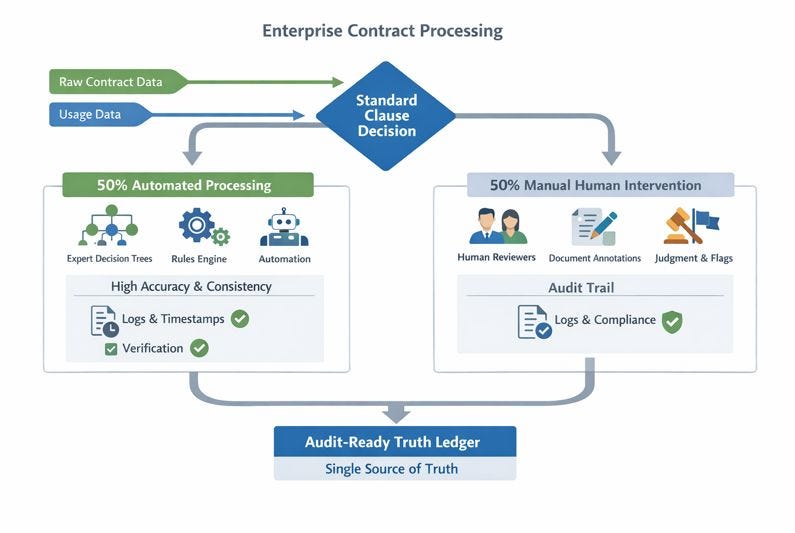
For Audit & Risk: This creates a Deterministic Truth Ledger. Instead of a “Material Weakness” risk where numbers are unverifiable, the system provides a transparent audit trail. Every financial output is substantiatable back to the source contract in seconds.
For Engineering: This eliminates “Spaghetti Logic.” The code “reads like a book,” allowing for surgical, low-risk changes. By decoupling complex business rules from the core engine, we reduced technical debt and ensured that any engineer could maintain the system without a week of specialized onboarding.
II. Strategic Bifurcation: The “Funnel” and Triage System
I realized early on that 100% automation is a “Brittle Metric.” In high-growth fintech, forcing high-variance enterprise contracts into rigid automation leads to Revenue Leakage and Manual Fix Cycles. I implemented a Strategic Funnel—a system designed to automate the core while surfacing complexity for expert review.
Automated vs. Out-of-Spec Triage: The logic acts as a filter. If all contract data supports standard automation, the engine executes fully. However, if the system detects “Out-of-Spec” triggers or high-variance contract attributes, it programmatically flags those exceptions.
“Yellow-Flag” Visibility: In simplest terms, the system “color codes” the data set. Standard transactions remain green, while exceptions are highlighted in yellow for human review. This ensures that the Ops team never has to go searching for errors; the system brings the specific high-impact decisions directly to them within the familiar data environment.
The 80% Efficiency Gain: I optimized a high-friction workflow that previously required hundreds of manual steps to move from raw usage to billable metrics. This process involved 12,000 manual inputs guided by dense, complex decision trees. By programmatically handling the data transformation and logical branching, 5 days worth of manual work was completed in just 1 day.
The 15-Minute Arrears Pipeline: I engineered the engine to process the entire billing lifecycle—moving from raw usage data ingestion through contract rate mapping to final billable metrics—in just 15 minutes.
High-Performance Architecture: Despite operating within a spreadsheet environment, I optimized the VBA engine using memory-resident data arrays to bypass slow cell-by-cell processing.
Early-Exit Logic: The engine utilizes an optimized traversal algorithm; as soon as a minimum entity (contract rate) reaches an end-node in the decision tree, the process exits the branch. This prevents unnecessary computation and ensures the system remains scalable as the dataset grows.
For Product Management: This solves the “Launch Blocker.” Product can say “Yes” to custom enterprise tiers and global tax complexities without triggering a massive engineering overhaul.
For Revenue Operations: We moved from “Firefighting” to Strategic Mastering of Variance. This bifurcation reclaimed 50% of team bandwidth, allowing the team to focus on growth rather than acting as “Human Glue” for broken code.
III. The Strategic Ownership: Architecting the $18M Truth Ledger
I am most proud of transitioning the infrastructure from a state of “Operational Chaos” to a state of Technical Rigor. By identifying the systemic risks of solo-dependency early, I have implemented a framework built for Institutional Memory and Perfect Scalability.
For Executive Leadership: This transformation secured an $18M portfolio by ensuring financial integrity.
Dispute-Proof Invoicing: Because billable metrics are derived from a deterministic “Bilingual” process, the bulk-uploaded N30 invoices carry a high degree of confidence. If a merchant questions an invoice, the “Truth Ledger” allows the Finance team to substantiate the exact usage-to-rate mapping immediately, significantly reducing the Days Sales Outstanding (DSO) and improving cash flow predictability.
The Result: A system that doesn’t just process data, but provides total visibility into Revenue Certainty. The methodology proved that you can achieve both high velocity and 99.9% accuracy if you build on a Bilingual foundation.